


When a teenage Matthew Gray was crawling through the mud at Kapooka, he had no idea what journey he was about to embark on, one that took him from Wagga Wagga to the Middle East and now, the big screen.
In 2002, Matt enlisted in the Australian Army. He served with the Royal Australian Armoured Corps, where he trained for his first major role with the Second Cavalry Regiment (2CAV) and a new life inside an Australian Light Armoured Vehicle (ASLAV).
‘There’s a bit of pressure and responsibility, working with mechanised vehicles,’ he said.
‘I learned very fast that you can’t fake it; you’ve gotta put in the time to learn and work.
‘You’ve gotta work for your brothers towards the common goal.’
Matt likened military life to that of a professional athlete: you spend 99% of your time preparing for the 1%. After the 2003 Invasion of Iraq, Matt was called up to play a small part on the world stage, and in 2004, he deployed with 2CAV as part of Security Detachment VI (SECDET 6), an experience he is proud of.
‘Our role was to protect officials, diplomats, and politicians. You spend so much time training; it’s rewarding to finally get to do the job,’ he said.
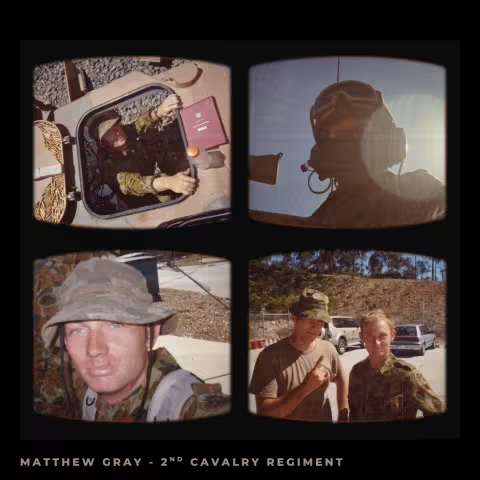
Matt loved playing his role in 2CAV.
After 15 years of service, Matt medically separated from the Army and was cast into a new role as a civilian. Without a script or director at the helm, Matt found the transition experience challenging.
‘You start playing a character, a stereotype, without even realising it,’ he said.
‘I felt like a failure, like a leper, for medically discharging.
‘I was angry at myself for being broken, and I drank every day for over a year when I got out.
‘But the answer wasn’t at the bottom of a bottle.’
On his journey to reinvent himself post-service, Matt found the courage to ask for help and started counselling. That decision opened an unlikely door when the counsellor suggested Matt try an acting class.
It was a culture shock for Matt, who traded years of sweating inside an ASLAV for sweating under stage lights. Still, the creative process helped him develop an invaluable skill that’s empowered him to rebuild his life: how to be vulnerable, or as he puts it, get comfortable being uncomfortable.
‘The creative arts bring out your vulnerability… that can be scary,’ he said.
‘The more you try to hide and contain it, the more it's exposed.
‘Emotions are like explosives; if you hold it for too long, it’ll blow you apart.
‘Acting helped me process my emotions without a need for containment.’
At first, acting may sound like a far cry from the rigours of ADF service, but Matt’s story highlights how important it is not to undervalue the transferable skills veterans develop. In hindsight, Matt says acting is a perfect fit for veterans because it requires taking direction, working with others, and, in some roles, bringing authenticity to entertainment with a military focus.
By daring to step outside of his comfort zone, Matt has found a new career on the silver screen, earning his first big break in a leading role as Lieutenant Briggs in 2026’s action flick Land of Wolves. But acting isn’t just Matt’s new career; it’s a way for him to connect with his children, who can’t believe it when their dad is on the couch and on screen simultaneously.
‘I’ve started teaching them about the creative process, the writing, the auditioning, the acting,’ Matt said.
‘I love being able to share this journey with my family.’
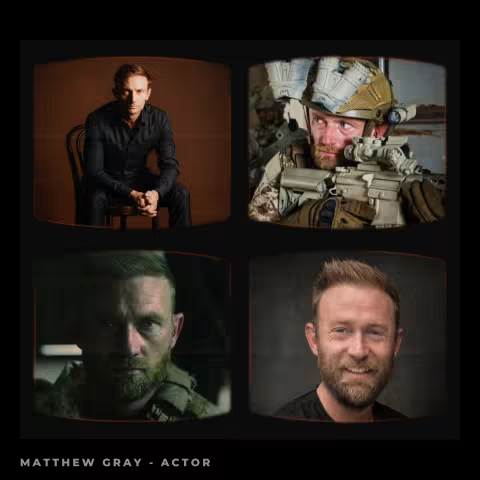
Learning to be vulnerable changed Matt's life.
Creative expression lowers stress, eases anxiety, and gives people a genuine sense of agency in their own lives. It's not about becoming the next George Lucas, Frida Kahlo or Stephen King. It's about carving out a space each week to feel your feelings and create something meaningful to you.
Matt encourages any veteran or family member struggling with their wellbeing post-service to give the creative arts a crack.
‘It doesn’t matter if it's writing, painting, or acting, be willing to give it a go,’ he said.
‘It’ll help you pull yourself out of that pit.’
If you’re looking for meaningful activities or support to improve your wellbeing but don’t know where to start, visit our wellbeing resources page or call us on 1800 823 922.


